Popular Courses
MCAT
General Course
Intro to Physics
University Study Guides
Physics
General Course
PHYS 157
University of British Columbia
Intro to Physics
University Study Guides
PHYS*1080
University of Guelph
PHYS*1080
University of Guelph
PHYS 223
University of Calgary
PHY 1122
University of Ottawa
PHYS 142
McGill University
ENGG 212
University of Calgary
ENGG 212
University of Calgary
PHYS 111
University of Victoria
PHYS 1050
University of Manitoba
PHYS 101
Simon Fraser University
PHYS-1300
University of Windsor
PHYS 121
University of Waterloo
PHYS 227
University of Calgary
SC/PHYS 1411 3.00
York University
PCS 110
Toronto Metropolitan University

0:00 / 0:00
Specific Heat & Calorimetry
- Heat required to change the temperature of mass by is:
- is called specific heat of the material which is the heat required to change the temperature of 1 kg of a material by 1 degree of Kelvin
- means that heat is added to the material and means that heat is removed from the material
Specific Heat For Different Material
Phase Change
- The heat required to change the phase of the material at a constant temperature is:
- Where in this equation could be:
- (heat of fusion) for melting
- (heat of vaporization) for vaporization
- Phase change happens at constant temperature!
- Phase change is a reversible process
- During a phase change both phases co-exist!
- For example: mixture of ice and water at
Heat of Fusion & Vaporization for Common Substances
Example
Below is a phase change diagram of a material by adding heat to it at a constant rate

0:00 / 0:00
Example: Calorimetry
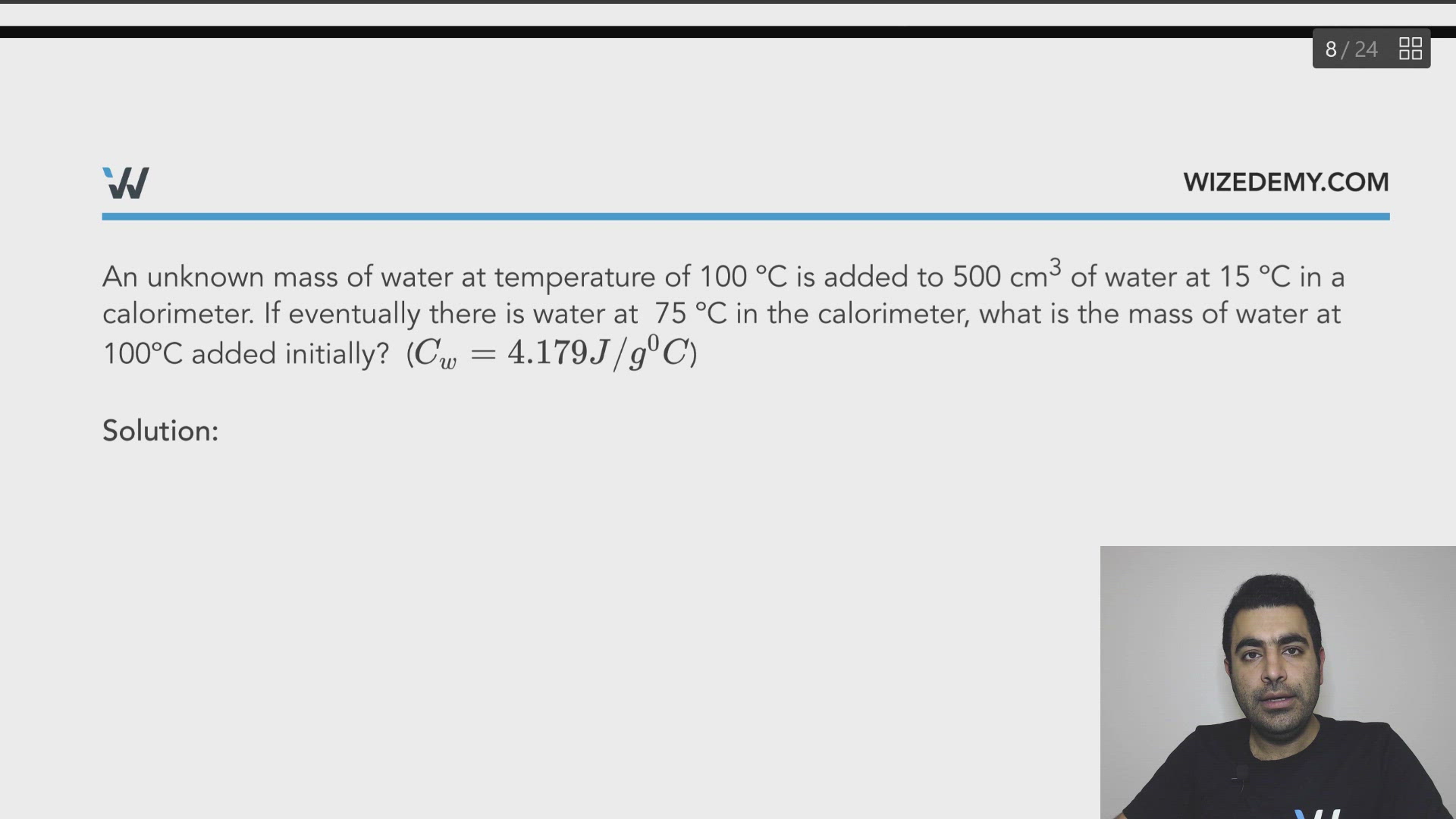
An unknown mass of water at temperature of 100 ºC is added to 500 cm3 of water at 15 ºC in a calorimeter. If eventually there is water at 75 ºC in the calorimeter, what is the mass of water at 100ºC added initially? ()
Solution:
0:00 / 0:00
Example: Phase Change
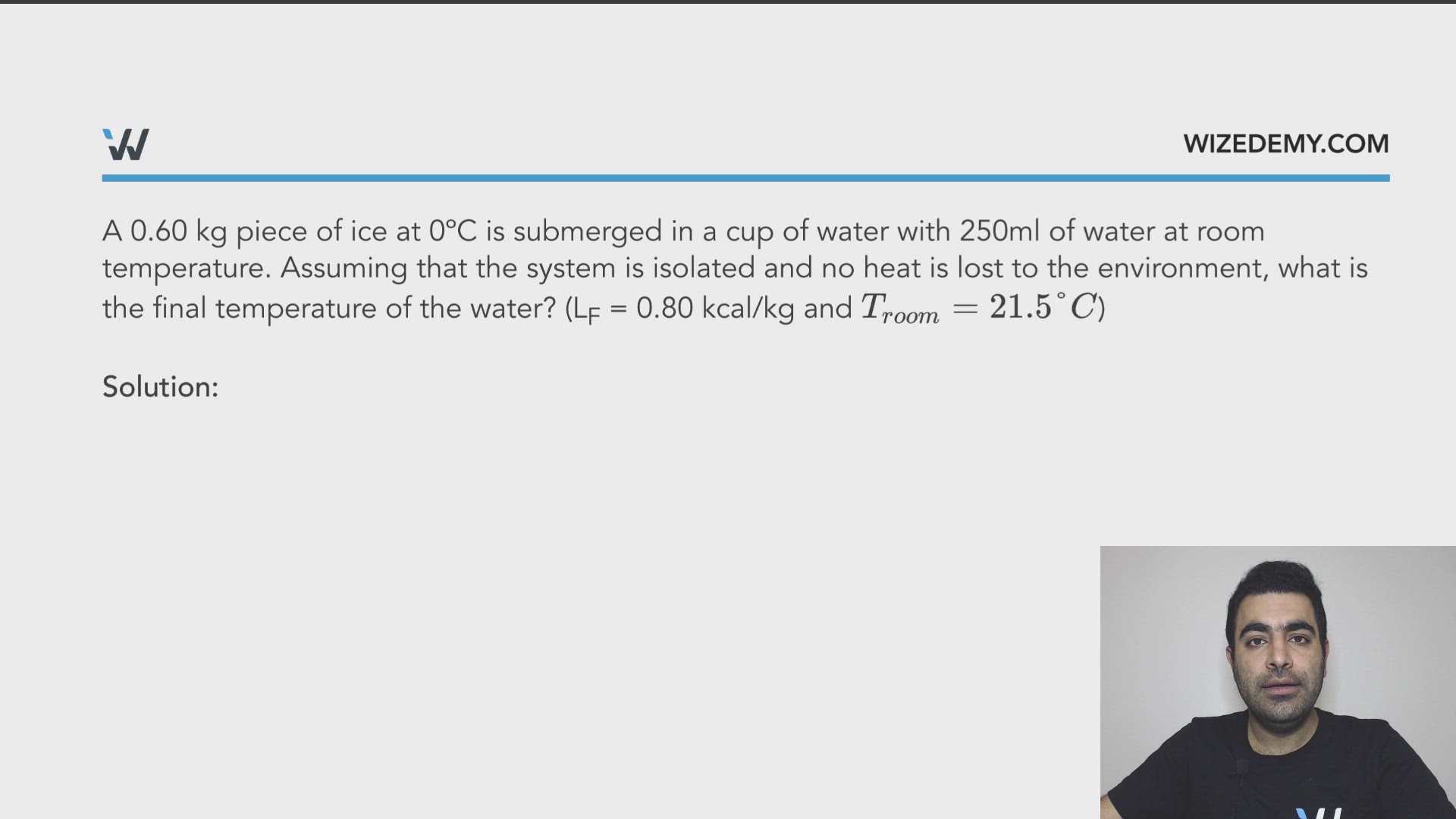
A 0.60 kg piece of ice at 0ºC is submerged in a cup of water with 250ml of water at room temperature. Assuming that the system is isolated and no heat is lost to the environment, what is the final temperature of the water? (LF = 0.80 kcal/kg and , )
Solution:
Answer the following questions:
Part 1
If we add one ice cube at into a glass with of water at , what is the final temperature at thermal equilibrium? (in degrees of Celcius)