Wize University Biology Textbook > Photosynthesis
Photosynthesis: Light and Dark Reactions [short]
Popular Courses
AP Biology Exam Prep Course
AP Exam Prep
Biology
General Course
General Biology
University Study Guides
BIOLOGY 1002B
Western University
BIOL 211
University of Calgary
BIOL 112
University of British Columbia
Grade 12 Biology
Canada High School
High School Biology
US High School
DAT
General Course
General Biology
University Study Guides
BIOL 130
University of Waterloo
BIOL 186
University of Victoria
BIOL 1201
Western University
BISC 101
Simon Fraser University
BIOL 1011
Dalhousie University
BIOL 1P91
Brock University
BIOLOGY 2601A/B
Western University
BIOLOGY 2601A/B
Western University
BS 161
Michigan State University
BIOL 331
University of Calgary

0:00 / 0:00
Photosynthesis Overview
Photosynthesis is a series of light-driven reactions which converts atmospheric CO2 to organic molecules and O2.

Stage I: Light Reactions
- The overall goal of the light reactions is to convert light energy into chemical energy in the form of ATP and NADPH.
- Using light energy harnessed by pigments (such as chlorophyll), electrons are excited and passed along the electron transport chain (ETC) to set up an electrochemical proton gradient which is used to drive ATP synthesis.
- The final electron acceptor is NADP+ which becomes NADPH.
Photosystems
- Pigments are organized in photosystems.
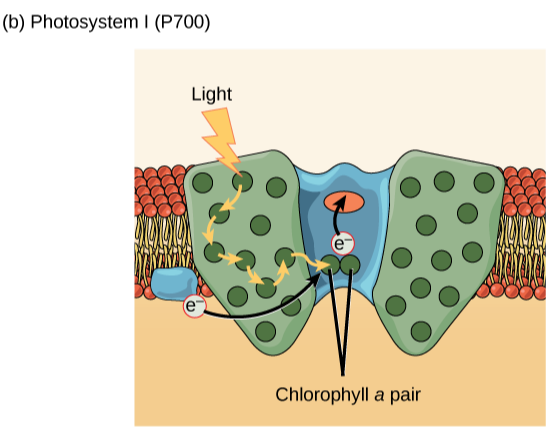
- A photosystem has two parts: the light harvesting (antenna) complex + the reaction center.
- They both:
- Absorb light energy;
- Pass it from pigment to pigment in the light harvesting complex;
- Energy ends up exciting chlorophyll a in the reaction center;
- Chlorophyll a gives off an electron to an electron acceptor.
- In photosystem II:
- Chlorophyll a regains electrons it lost by splitting water (releases O2).
- The excited electron is passed down members of the electron transport chain (ETC).
- Its energy is used to drive protons (H+) into the lumen.
- The electron ends up in chlorophyll a of photosystem I.

- In photosystem I:
- Absorbs light energy, gives off an electron and passes it to an enzyme which uses the electrons to reduce NADP+ to NADPH.
- The electrons donated by the reaction center are replaced by photosystem II.
- Proton gradient is used to generate ATP by ATP Synthase.
Stage II: Dark Reactions (Calvin Cycle)
- Happens in the stroma.
- ATP and NADPH that result from Stage I are used for carbon fixation (production of organic molecules from CO2).
- Rubisco is the main enzyme responsible for combining CO2 with an organic molecule.
- Glyceraldehyde-3-phosphate (G3P) is made. G3P is used to produce other sugars such as glucose.

Practice: The Chloroplast
About the chloroplast:
Practice: Overall Photosynthesis Reaction
Given the following overall photosynthesis reaction, fill in the missing components (left to right):
6 H2O + ______ --> ________ + 6 O2