Wize University Biology Textbook > The Cell Cycle
The Genome & Chromosomal Structure
Popular Courses
MCAT
General Course
BIOLOGY 1001A
Western University
Biology
General Course
General Biology
University Study Guides
BIOL 107
University of Alberta
BIOL 102
Queen's University
Grade 12 Biology
Canada High School
DAT
General Course
High School Biology
US High School
Grade 11 Biology
Ontario High School
Grade 11 Biology
Canada High School
BIOL 200
McGill University
BIOL*1090
University of Guelph
General Biology
University Study Guides
BIOL 130
University of Waterloo
SC/BIOL 1000 3.00
York University
Biology 20
Alberta High School
BIOL 311
University of Calgary
BIOL 184
University of Victoria
BIO 1141
University of Ottawa
0:00 / 0:00
The Gene and the Genome
The genome is all of the genetic material of an organism. The genome is encoded on one or more chromosomes (humans have 23 pairs of chromosomes – 46 total).
- Prokaryotic chromosomes are circular and are arranged into a nucleoid consisting of supercoiled DNA and protein.
- Eukaryotic chromosomes are linear.
- It is condensed by being wound around proteins called histones to form nucleosomes, which are then arranged into chromatin fiber. This is further condensed by coiling.
- If the DNA in the cell wasn't well organized, it would be like a huge pile of spaghetti will super long noodles that you can't get apart (or imagine 5 pairs of headphones in your pocket at once... but way, way worse).

Genes
Polypeptides (proteins), and different kinds of RNA are encoded by genes.
- Genes are sequences of DNA nucleotides. A gene contains the following information:
- The sequence of nucleotides required for the initiation and termination of transcription of the gene (i.e. the promoter and the terminator).
- The sequence of nucleotides that code for a mature RNA molecule, called exons, plus introns (regions that are removed before protein is made).
Chromosomes
Each species has a specific number of chromosomes. Humans have 46 chromosomes in a somatic cell (that is, 23 pairs), while dogs for example, have 78.
- Humans, along with many other species, are diploid, meaning we have two copies of each of our chromosomes (2n).
- This means that our cells contain 23 pairs of chromosomes, giving 46 chromosomes total.
- In humans, one copy of each chromosome comes from your mom, while the other copy of each chromosome comes from your dad.
- Some organisms contain only one copy of each chromosome, and they are said to be haploid (1n).
- It is possible for organisms to have more than two copies of each chromosome. This is called polyploidy.
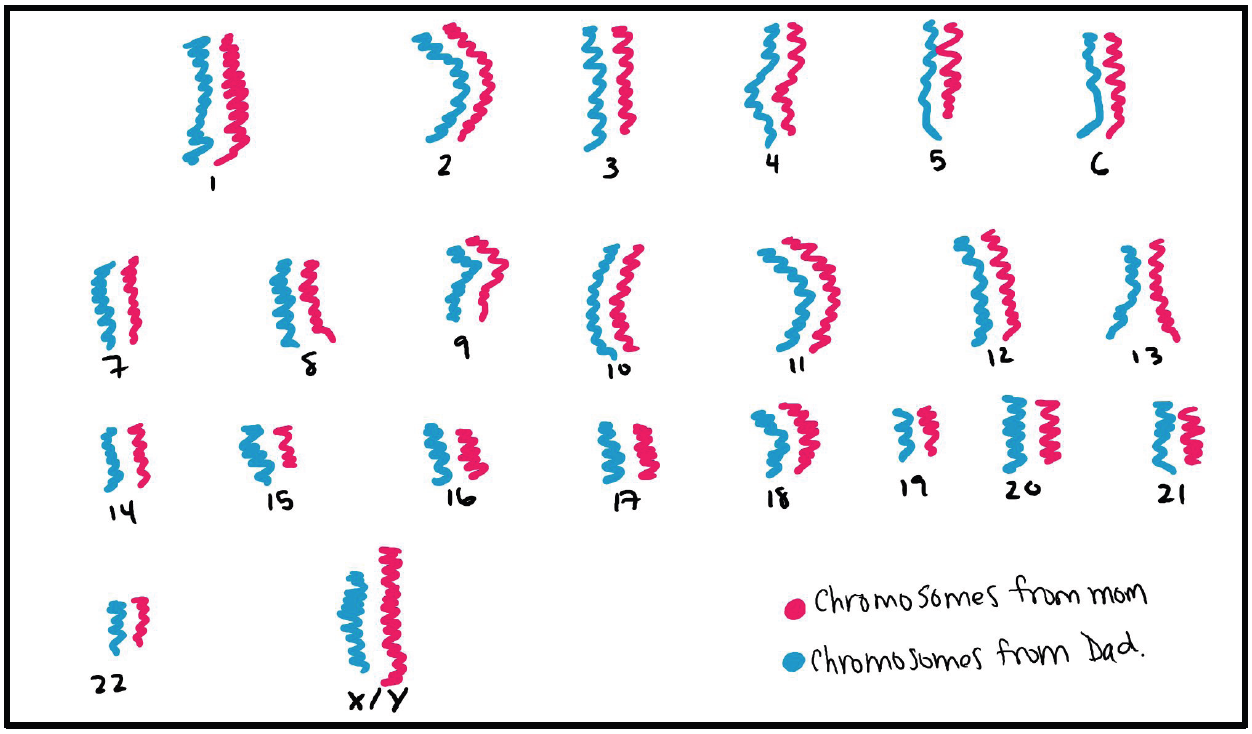
The pair of chromosomes that came from each parent is called a homologous pair.
- The homologous pairs of chromosomes contain the same types of genes, but usually different alleles of each gene.
- An allele can be thought of as a different version of a gene. Example: Let's say chromosome 16 has a gene that encodes for hair color. Each individual has two chromosomes #16, let's call them M and D (for Mom and Dad). At the same location on both chromosomes (locus), there will be a sequence of nucleotides that encodes for a protein that determines your hair color. While on the M chromosome this sequence may be for blonde hair, on the D chromosome it may be for red hair. These two different versions of the same gene are called alleles.
- The sex chromosomes determine if a person will be male or female.
- Two X chromosomes: female.
- One X and one Y chromosome: male.
- Non-sex chromosomes are called autosomes.
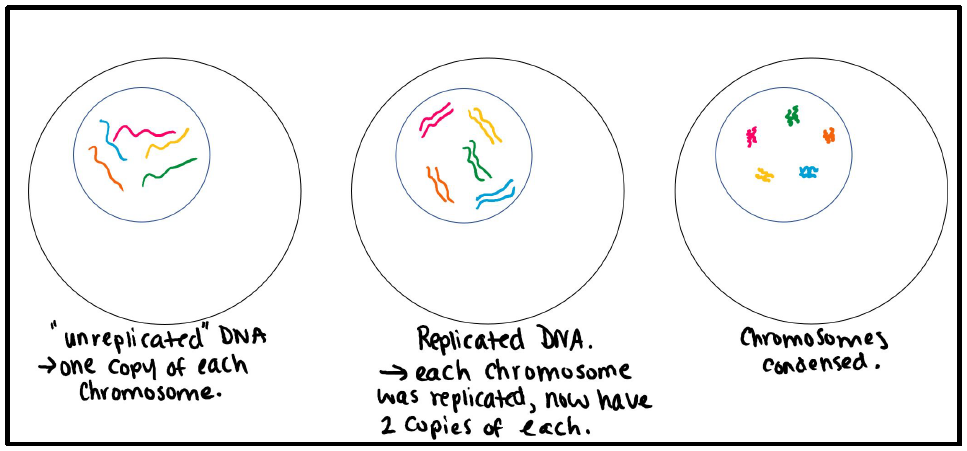
- When a cell divides, the chromosomes need to be replicated.
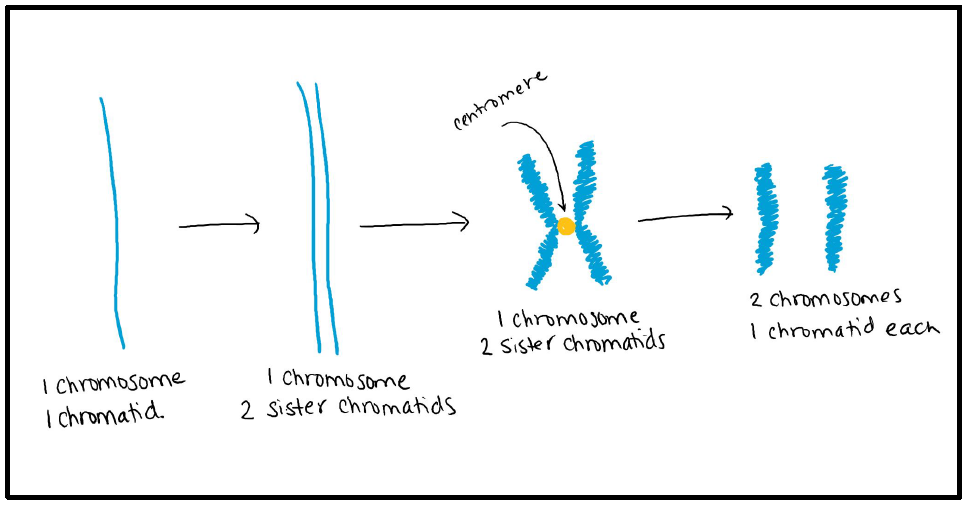
- When the DNA is replicated, each identical copy of a chromosome is called a sister chromatids, and are attached to one another by a centromere.
DNA replication and division
- After the DNA is replicated, it becomes condensed, and the sister chromatids are attached by the centromere.
- In this state, they two sister chromatids are still considered 1 chromosome.
- When the cell starts to divide into two cells, each sister chromatid is pulled apart. Once separated, they are now considered two chromosomes.
Watch Out!
Homologous chromosomes and sister chromatids are not the same thing!
Practice: Chromosome Number
You believe you and your friend have found a new species. You want to test its DNA to be sure. You find that a single cell of the animal contains 24 sister chromatids and the animal is haploid. How many chromosomes does this cell have?