Wize University Biology Textbook > The Cell Cycle
The Cell Cycle
Popular Courses
MCAT
General Course
BIOLOGY 1001A
Western University
Biology
General Course
General Biology
University Study Guides
BIOL 107
University of Alberta
BIOL 102
Queen's University
Grade 12 Biology
Canada High School
DAT
General Course
High School Biology
US High School
BIOL 121
University of British Columbia
BIOL*1090
University of Guelph
General Biology
University Study Guides
BIOL 130
University of Waterloo
SC/BIOL 1000 3.00
York University
BIOL 200
University of British Columbia
BIOL 311
University of Calgary
BIOL 184
University of Victoria
BIO 1141
University of Ottawa
BLG 143
Toronto Metropolitan University
BIOL 112
McGill University

0:00 / 0:00
Phases of The Cell Cycle
The central feature of life is that organisms grow, reproduce and die. Just like humans go through different stages in our growth and development, so do each of our cells.
- The cell cycle is like the lifecycle of a cell – from the beginning of a new cell, through growth, and finally division.
- Some cells are capable of dividing many times, while others are not.
- In order to divide, a cell must go through its "stages of life". In this time, the following things will happen:
- The cell will grow;
- It will replicate its DNA;
- It will produce new organelles;
- As it nears cell division, it will sort the DNA so that each daughter cell receives one copy of each chromosome;
- Split into two cells (twin daughter cells).
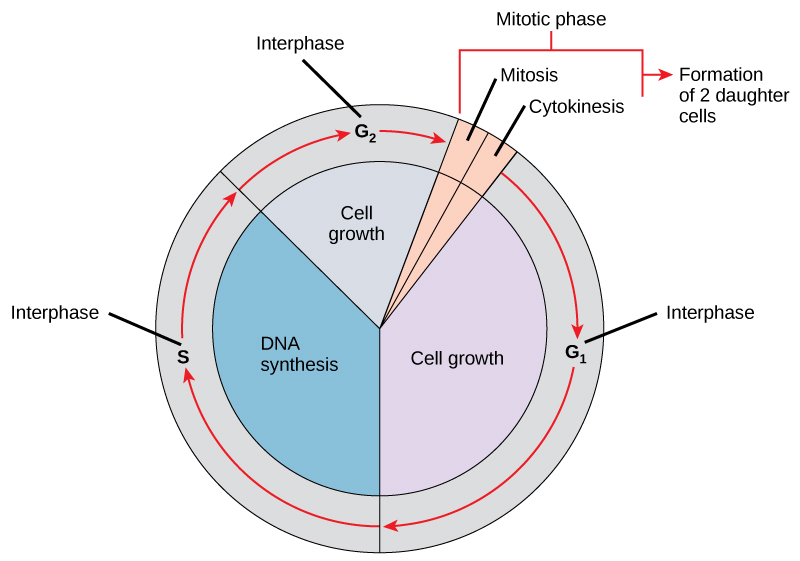
The cell cycle can be divided into 2 major phases:
- Interphase: Cell growth and DNA replication.
- G1 phase (1st gap)
- S phase (Synthesis)
- G2 phase (2nd gap)
- Mitotic (M) Phase: Replicated DNA and cell contents are separated.
- Mitosis
- Cytokinesis (partitioning of the cytoplasm)
Wize Tip
Think about it like this: cells can only think about reproduction! The cell is either waiting and preparing to divide (interphase), or is dividing (dividing).
Interphase
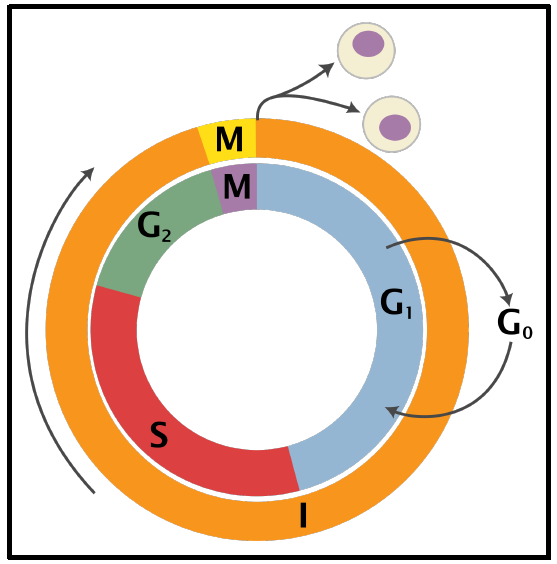
Interphase can be split into three separate phases:
- G1 phase: Gap phase 1.
- The cell is stocking up on nucleotides, proteins and energy to replicate its DNA. That is, it increases abundance of molecules involved in replication.
- S phase: Synthesis phase.
- The cell replicates its DNA to form sister chromatids, and replicates the microtubules organizing center called the centrosome.
- DNA remains in semi-condensed chromatin form.
- G2 phase: Gap phase 2.
- The cell may grow in size and increases abundance of proteins involved in mitosis (i.e. chromosome movement and manipulation).
- It also replenishes energy stores and some organelles are duplicated.
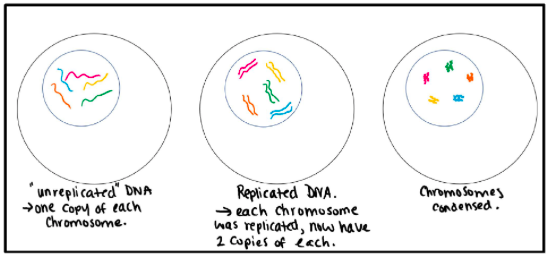
- There may also be a G0 phase, in which the cells exist in a quiescent state (quiet) and they are not in the process of dividing or preparing to divide. This can sometimes be seen as an extended G1 phase.
- May be temporary (e.g. due to lack of nutrients);
- May be permanent (e.g. adult heart cells usually do not divide).

Mark Yourself Question
- Grab a piece of paper and try this problem yourself.
- When you're done, check the "I have answered this question" box below.
- View the solution and report whether you got it right or wrong.
Practice: Cell Cycle
Draw a somatic cell that is n = 5 in G1 phase and G2 phase.