Wize University Biology Textbook > The Cell Cycle
Mitotic Phase of Cell Cycle
Popular Courses
MCAT
General Course
BIOLOGY 1001A
Western University
Biology
General Course
General Biology
University Study Guides
BIOL 107
University of Alberta
BIOL 102
Queen's University
Grade 12 Biology
Canada High School
DAT
General Course
High School Biology
US High School
BIOL 121
University of British Columbia
BIOL*1090
University of Guelph
General Biology
University Study Guides
BIOL 130
University of Waterloo
SC/BIOL 1000 3.00
York University
BIOL 311
University of Calgary
BIO 1141
University of Ottawa
BLG 143
Toronto Metropolitan University
BIOLOGY 2581A/B
Western University
BIOL 112
McGill University
HMB265H1
University of Toronto

0:00 / 0:00
Mitotic Phase
Mitosis (M Phase) is the part of the cell cycle in which a cell divides into two identical daughter cells, which are genetically identical to each other as well as the "mother" cell.
- Recall that the M Phase of the cell cycle can be subdivided into mitosis and cytokinesis.
- The first portion is also called karyokinesis, which literally just means division of the nuclear contents.
- The second portion, cytokinesis, means separation of the cytoplasmic components into two daughter cells.
- Most of the cell division in our bodies occurs through mitosis.
- Mitosis is for growth, and to replace old and dying cells.
Wize Tip
Remember that "-kinesis" just means motion.
Phases of Mitosis
- Prophase
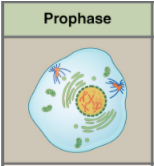
- Chromosomes start to condense.
- Centrosome begins to form the mitotic spindle structure composed of microtubules which organize chromosomes and move them to the appropriate locations during mitosis.
- The spindle gets longer as the centrosomes move to opposite poles of the cell.
- The nucleolus disappears and nuclear envelope breaks down.
- Prometaphase
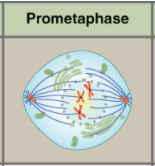
- Chromosomes continue to further condense.
- The mitotic spindle grows and begin to attach to the kinetochore of the chromosomes' centromere.
- The kinetochore is a protein located at the centromere of the sister chromatids.
- Metaphase
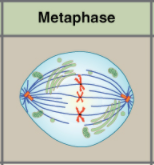
- Chromosomes align at the metaphase plate (also sometimes called the equatorial plane).
- The two kinetochores of each chromosome (one for each sister chromatid) are attached to microtubules – each attached to an opposite centrosome.
- Maximal condensation of chromosomes, but chromatids are still attached to one another.
Wize Tip
Chromatids align like the stars in order for the cell to divide... that's so meta!
- Anaphase
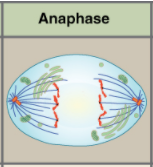
- Sister chromatids separate and are pulled towards opposite ends of the cell towards the two centrosomes.
- Now they are each one chromosome!
- The microtubules that are not attached to chromosomes push apart, causing the cell to elongate and the poles to move away from each other.
- Telophase
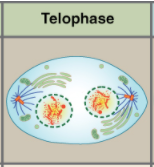
- The mitotic spindle is broken down into tubulin monomers that will form the cytoskeleton of daughter cells.
- Chromosomes start to decondense.
- Nuclear envelope begins to form.
Wize Tip
Cells are telling each other good bye!

0:00 / 0:00
Cytokinesis
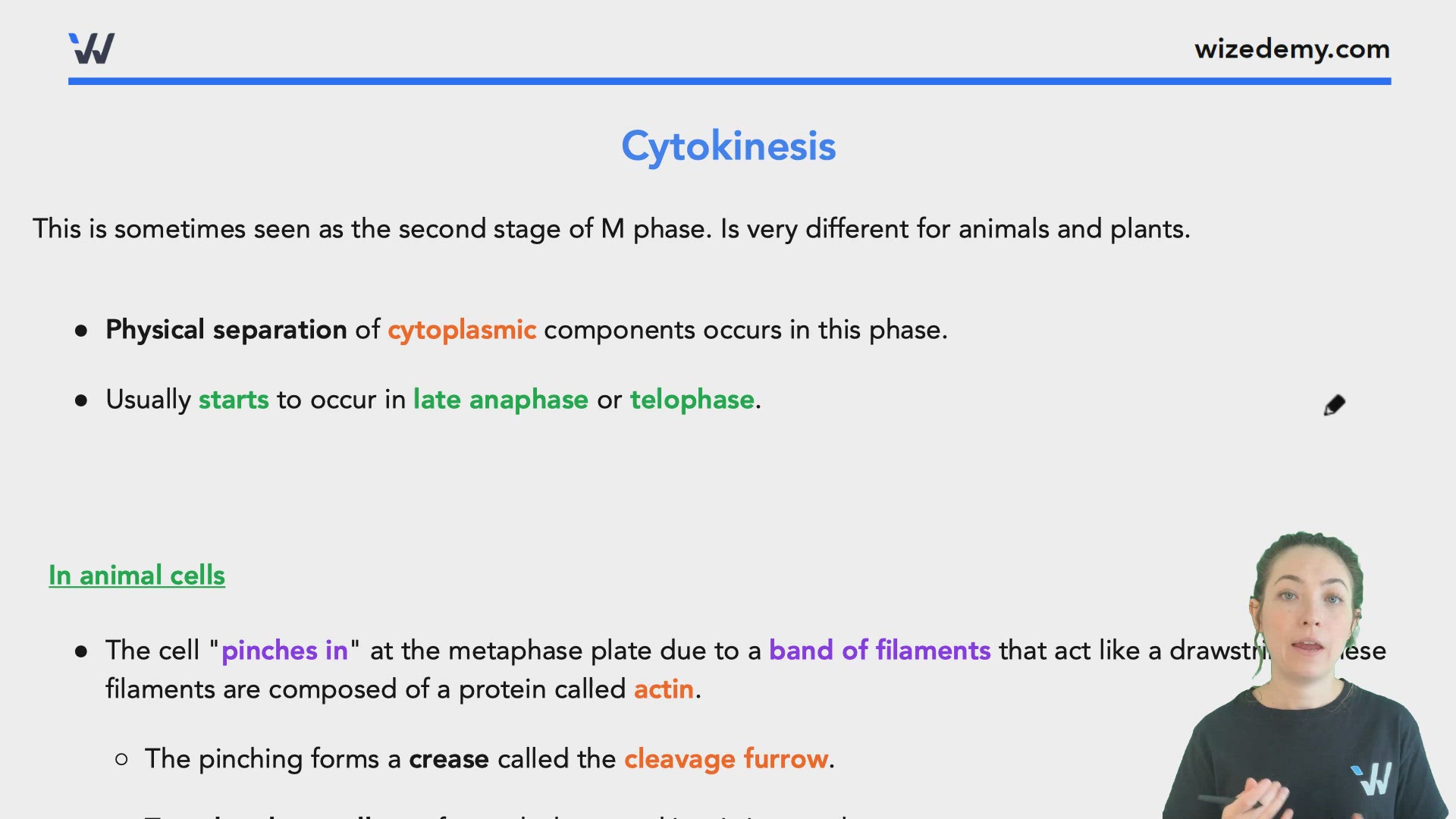
This is sometimes seen as the second stage of M phase. Is very different for animals and plants.
- Physical separation of cytoplasmic components occurs in this phase.
- Usually starts to occur in late anaphase or telophase.
In animal cells
- The cell "pinches in" at the metaphase plate due to a band of filaments that act like a drawstring. These filaments are composed of a protein called actin.
- The pinching forms a crease called the cleavage furrow.
- Two daughter cells are formed when cytokinesis is complete.
In plant cells
- Remember that plants have cell walls, composed of cellulose, so a new one must form between the daughter cells.
- Vesicles formed from the Golgi apparatus that contain the components necessary for this process (e.g. glucose) go to the metaphase plate.
- A cell plate forms down the middle, splitting the cell into two and forming a cell wall between them.

0:00 / 0:00
Ploidy & C-value coefficients
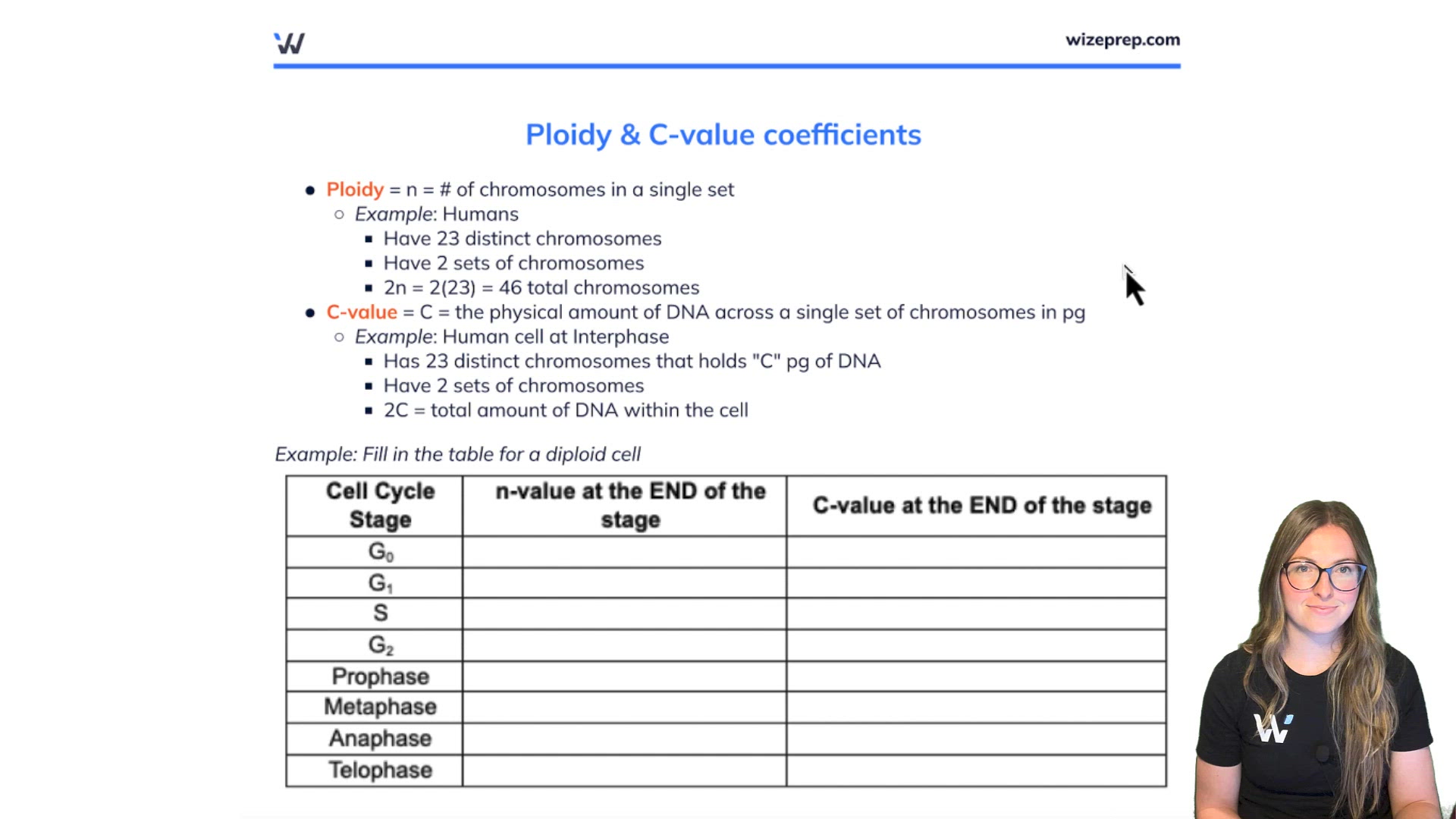
- Ploidy = n = # of chromosomes in a single set
- Example: Humans
- Have 23 distinct chromosomes
- Have 2 sets of chromosomes
- 2n = 2(23) = 46 total chromosomes
- C-value = C = the physical amount of DNA across a single set of chromosomes in pg
- Example: Human cell at Interphase
- Has 23 distinct chromosomes that holds "C" pg of DNA
- Have 2 sets of chromosomes
- 2C = total amount of DNA within the cell
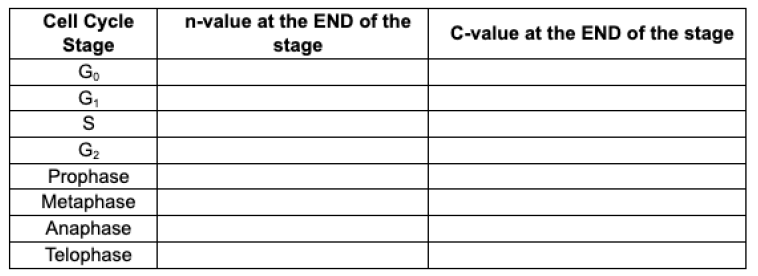
Example: Fill in the table for a diploid cell
Practice 1: Number of Chromosomes and Chromatids
Complete the following table based on a cell that is 2n = 12.
| # Chromosomes | # Chromatids | # DNA strands | |
| G1 Phase | |||
| G2 Phase | |||
| Metaphase | |||
| Anaphase | |||
| After cytokinesis (per cell) |
Practice: Lack of Actin
A human cell has received a mutation and is unable to produce actin. What would be the result after mitosis?
Practice: Chromosomes and Chromatid Number
If a cell contained 4 chromosomes during prophase, how many chromosomes and chromatids would it have during prometaphase?
Practice: Chromosomes During Metaphase and Anaphase
Dogs are . A somatic dog cell undergoes mitosis. How many chromosomes are there during metaphase and anaphase, respectively?