Wize University Biology Textbook > DNA Replication & Repair
Types of DNA Mutations
Popular Courses
MCAT
General Course
BIOLOGY 1001A
Western University
Biology
General Course
General Biology
University Study Guides
BIOL 107
University of Alberta
BIOL 102
Queen's University
BIOL 112
University of British Columbia
Grade 12 Biology
Canada High School
DAT
General Course
High School Biology
US High School
BIOL 200
McGill University
BIOL*1090
University of Guelph
BIO120H1
University of Toronto
General Biology
University Study Guides
BIOL 130
University of Waterloo
BIO 1141
University of Ottawa
BLG 143
Toronto Metropolitan University
BIOLOGY 2581A/B
Western University
BIOL 112
McGill University
BIOL 186
University of Victoria

0:00 / 0:00
Types of DNA Mutations
Mutations in DNA occur when there is a change in the normal DNA sequence.
Point Mutations or Base Substitutions
The term point mutation means that only one base pair is mutated. Point mutations can arise due to:
- Errors in DNA replication.
- Environmental exposure to damaging agents like UV light, radiation, etc.
- Harmful chemicals/ toxins.
- Byproducts of normal cell metabolism (e.g. lipid oxidation).
There are 3 types of point mutations:
- Nonsense mutation: a premature stop codon is introduced into a sequence Example: UGC (Cysteine) --> UGA (stop)
- Missense mutation: a change to the amino acid sequence Example: UGC (Cysteine) --> UGG (Tryptophan)
- Silent mutation: no change to the amino acid sequence Example: UGC (Cyteine) --> UGU (Cysteine)
Wize Concept
Mutations can be:
- BENEFICIAL: improves the fitness of an organism (e.g. resistance to a virus, lactose tolerance)
- BENIGN: does not change the overall fitness of an organism (e.g. change in eye color or silent mutations)
- HARMFUL: negatively impacts the fitness of an organism (e.g. development of diseases like cancer and birth defects)

Exam Tip
To remember that nonsense mutations cause stop codons, just remember the mnemonic: STOP the NONSENSE!
When a nucleotide is replaced by another this is called a base substitution. Most commonly, point mutations are base substitution.
- There are two different kinds of substitutions: transitions and transversions.
- Transitions: purine for purine, pyrimidine for pyrimidine. Example: A for G, C for T.
- Transversion: purine for pyrimidine and vice-versa. Example: A for T, C for G.

Frameshift Mutations
Other mutations have the potential of causing changes in the reading frame of the nucleotide sequence. These are called frameshift mutations. They can be caused by mutations such as insertions or deletions of fragments of DNA.

Wize Concept
You may not have covered what "reading frame" means yet in your biology course, so here's a quick explanation.
- The DNA sequence codes for proteins.
- Every 3 nucleotides codes for one amino acid.
- Therefore, when nucleic acids are translated into proteins, the triplets of nucleotides that are read can make a huge difference in the outcome of a protein. Example: consider the following sequence: TGTGAA. Reading in triplets, TGT codes for cysteine, while GAA is glutamic acid. So this sequence of amino acids is a cysteine linked to a glutamic acid. Now, consider I insert a random nucleotide in the middle of this sequence: TGTTGAA. Again, reading in triplets from left to right, now this codes for TGT = still cysteine, but the next triplet will be TGA = STOP. Turns out TGA is a stop codon, which tells the cellular machinery to STOP making this protein.
- Due to this single base insertion, the rest of the protein is now missing.
- This is an example of an insertion causing a shift in reading frame and a premature stop codon.
Practice: DNA Mutations
You are studying a DNA sequence and find a spontaneous mutation that has occurred, resulting in a nonsense mutation. Which of the following is true?
Practice: Type of Mutation
a) What type of point mutation occurred in the DNA sequence below, substitution, insertion, or deletion?
Initial sequence: 3’ ATGCGATTATCTAGTATT 5’
Mutated sequence: 3’ ATGCGATTATCTAGGTATT 5’
b) Does the mutation cause a frameshift, synonymous, missense, or nonsense mutation in the amino acid sequence?
0:00 / 0:00
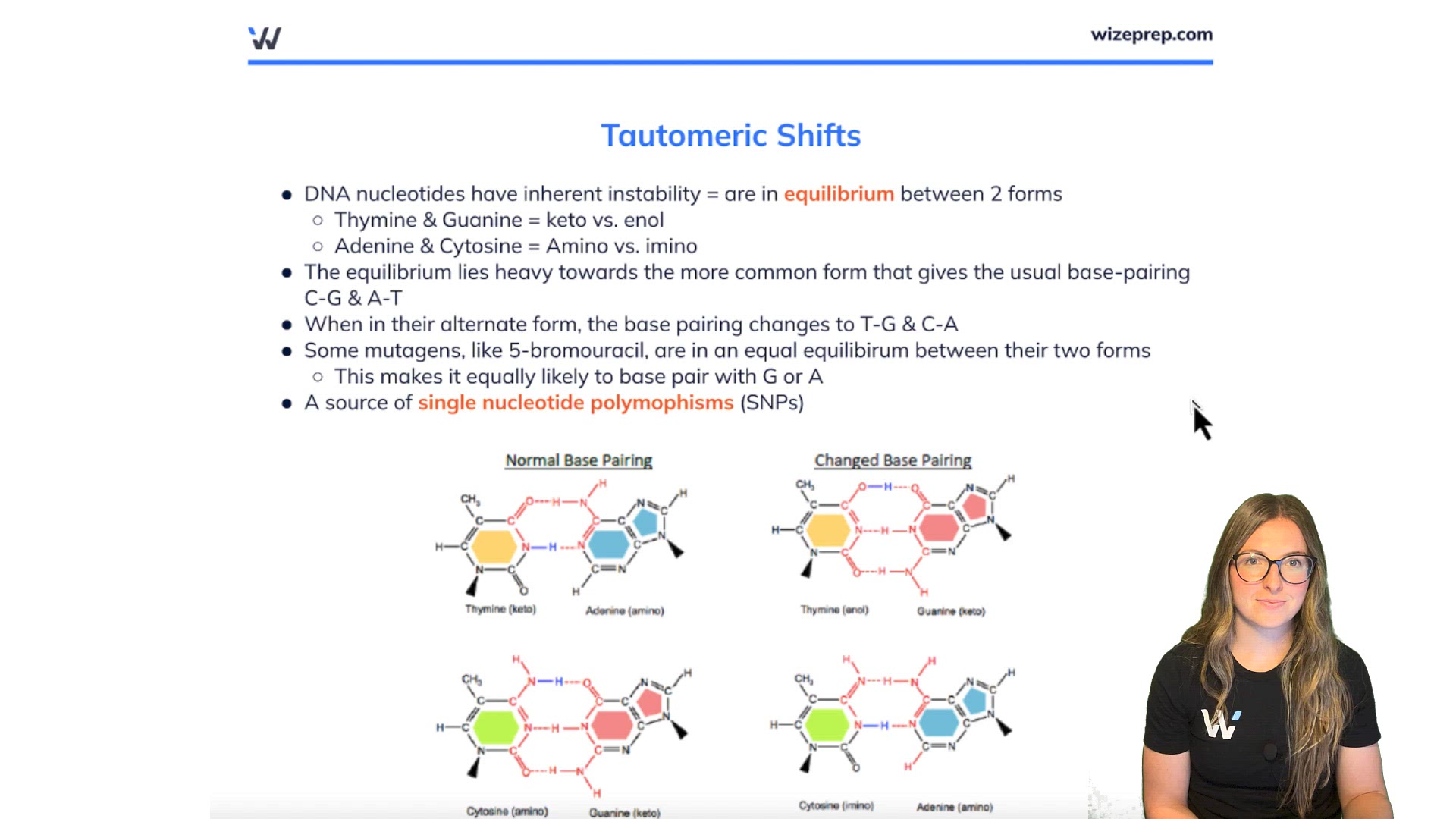
Tautomeric Shifts
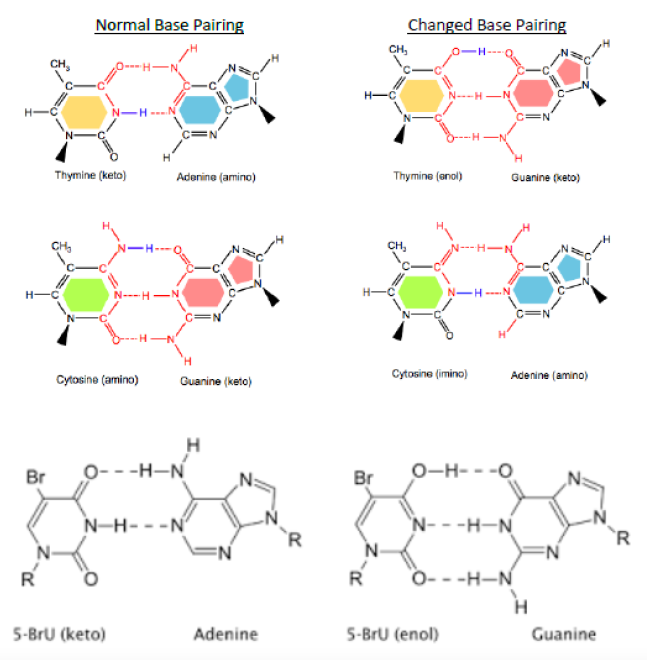
- DNA nucleotides have inherent instability = are in equilibrium between 2 forms
- Thymine & Guanine = keto vs. enol
- Adenine & Cytosine = Amino vs. imino
- The equilibrium lies heavy towards the more common form that gives the usual base-pairing C-G & A-T
- When in their alternate form, the base pairing changes to T-G & C-A
- Some mutagens, like 5-bromouracil, are in an equal equilibirum between their two forms
- This makes it equally likely to base pair with G or A
- A source of single nucleotide polymophisms (SNPs)
0:00 / 0:00
Example: Tautomeric Shifts
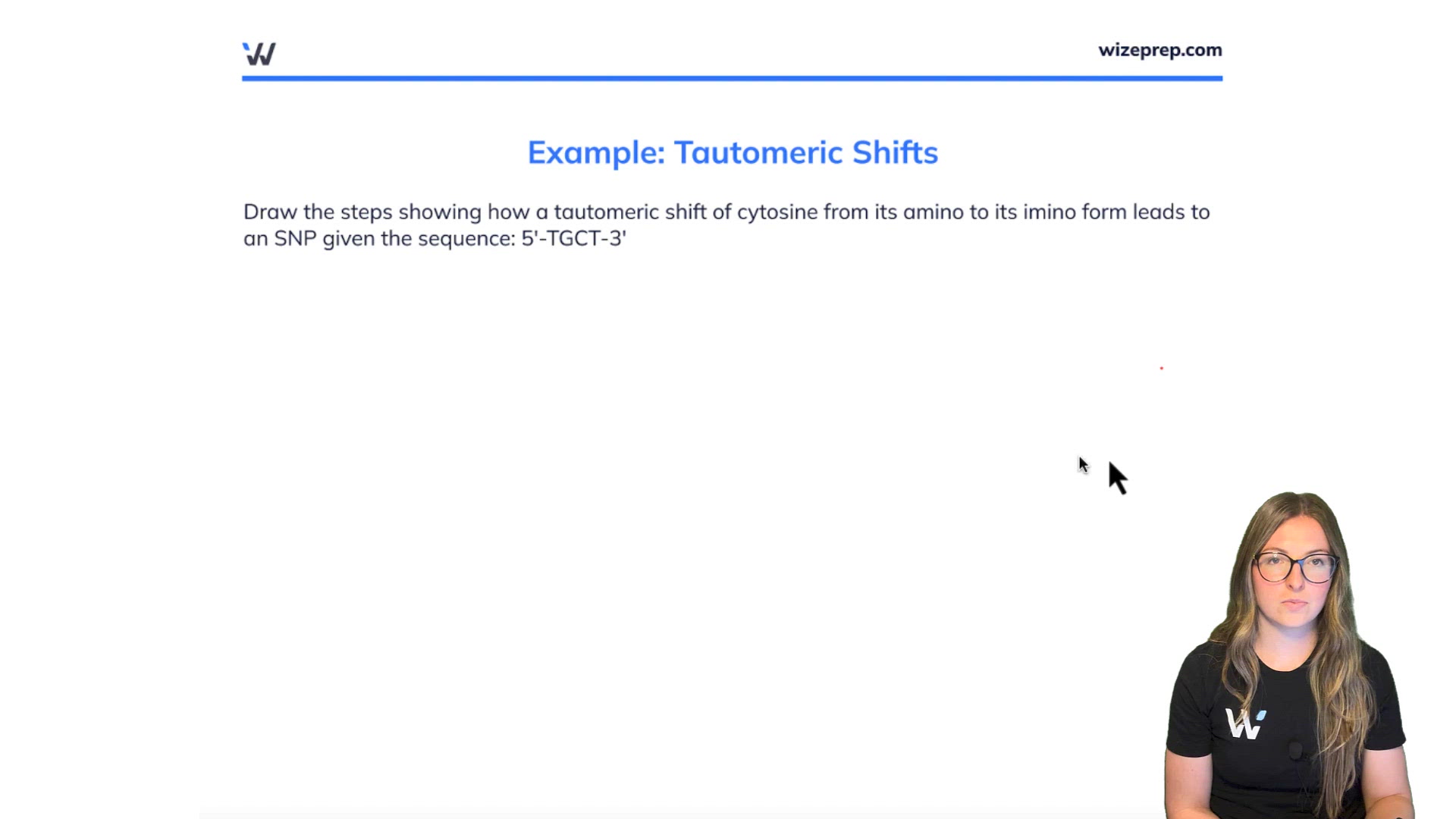
Draw the steps showing how a tautomeric shift of cytosine from its amino to its imino form leads to an SNP given the sequence: 5'-TGCT-3'
0:00 / 0:00
DNA Slippage
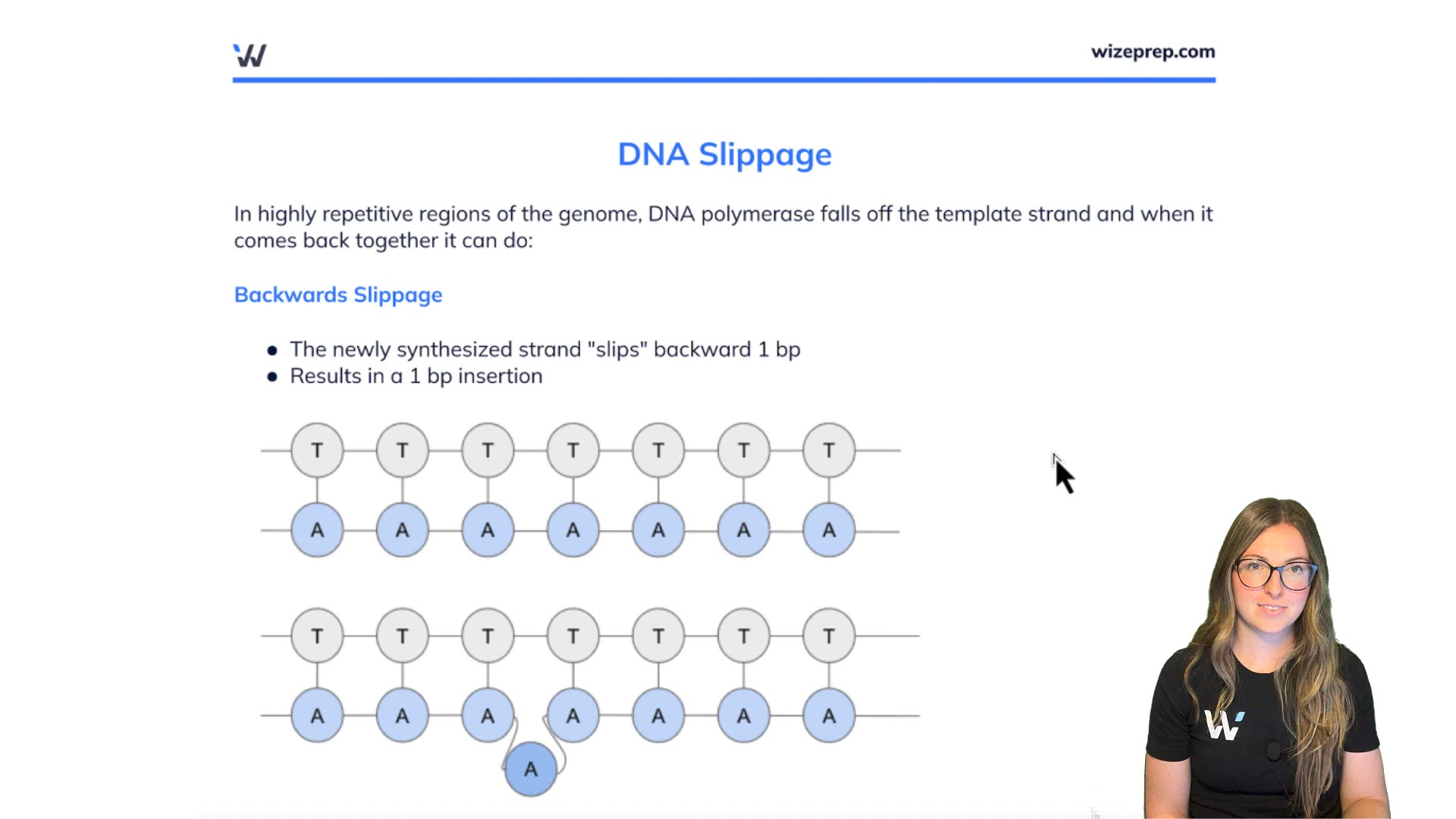
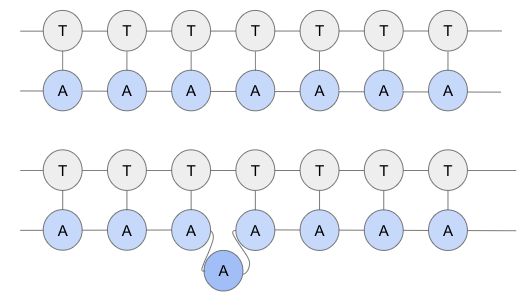
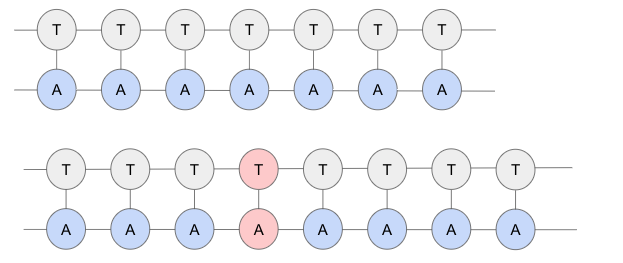
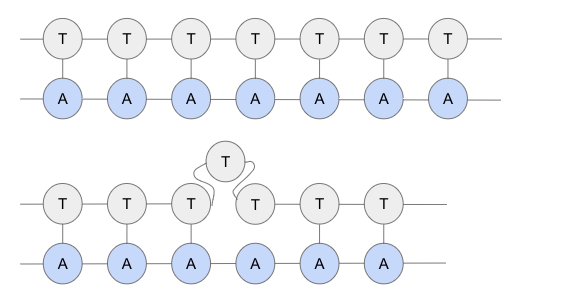
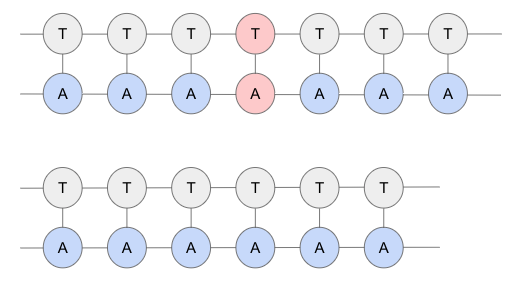
In highly repetitive regions of the genome, DNA polymerase falls off the template strand and when it comes back together it can do:
Backwards Slippage
- The newly synthesized strand "slips" backward 1 bp
- Results in a 1 bp insertion
Forward Slippage
- The template strand "slips" forward 1 bp
- Results in a 1 bp deletion
0:00 / 0:00
Copy Number Variations
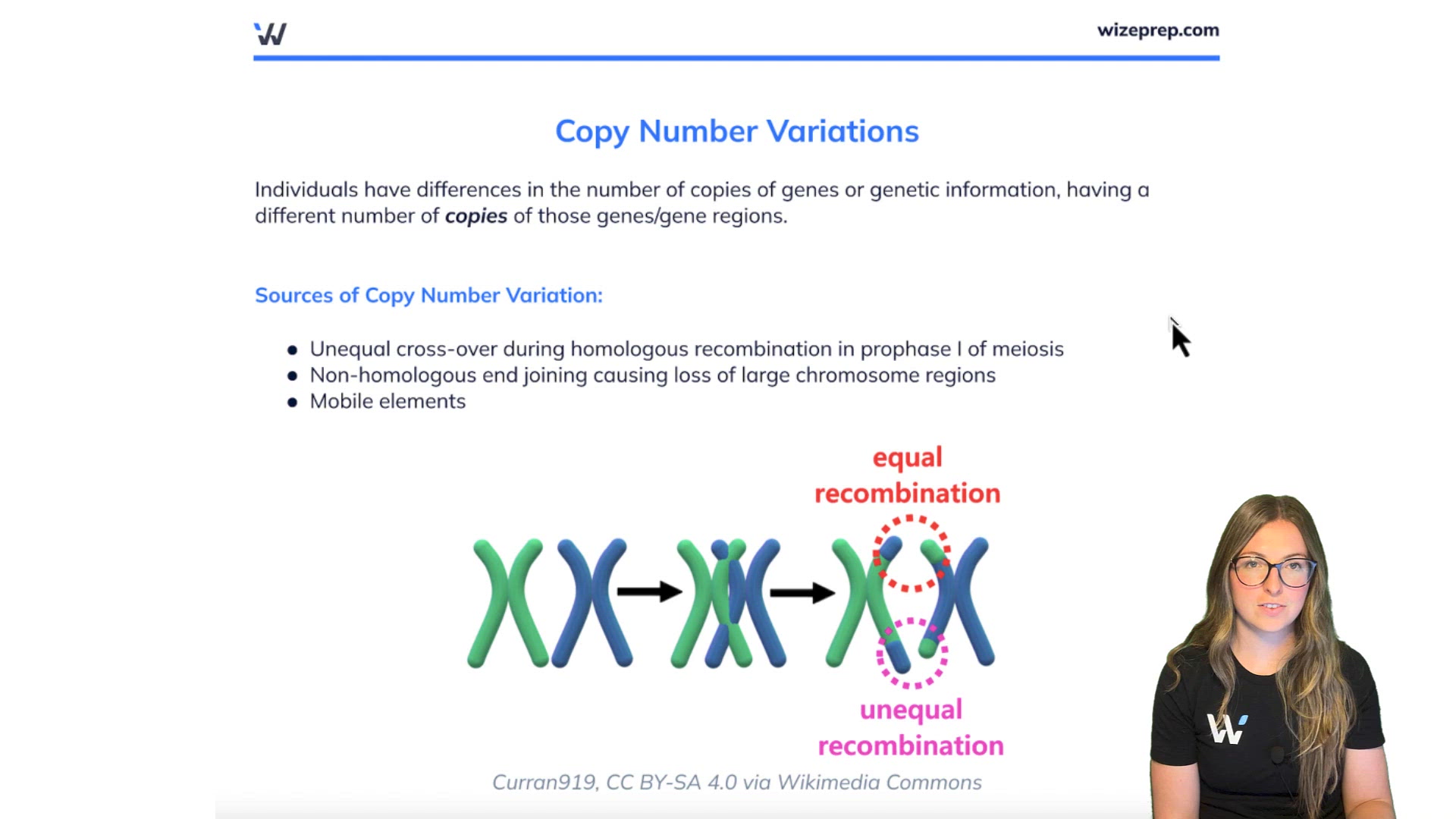
Individuals have differences in the number of copies of genes or genetic information, having a different number of copies of those genes/gene regions.
Sources of Copy Number Variation:
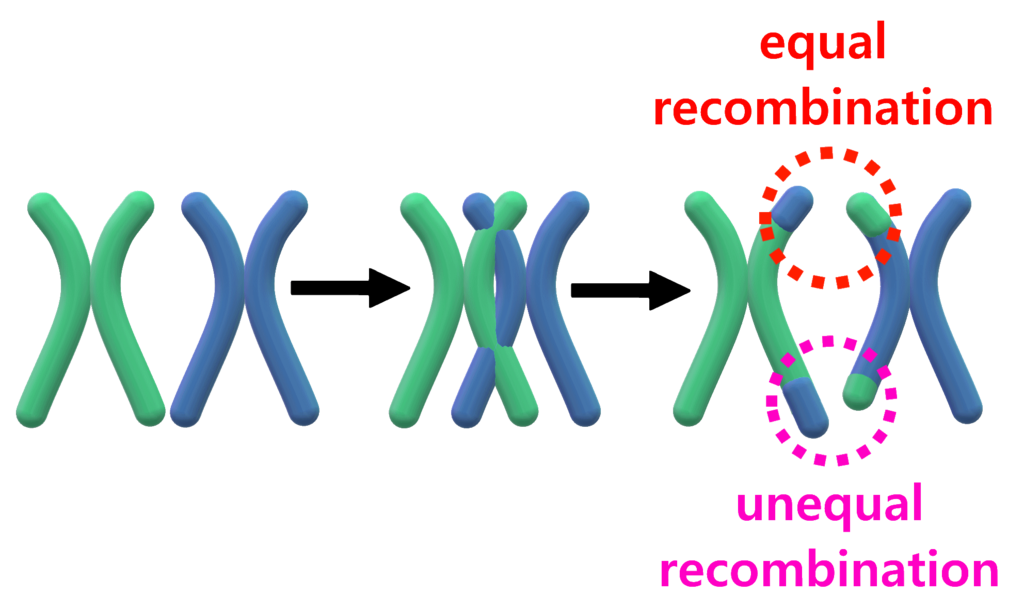
- Unequal cross-over during homologous recombination in prophase I of meiosis
- Non-homologous end joining causing loss of large chromosome regions
- Mobile elements
Curran919, CC BY-SA 4.0 via Wikimedia Commons
0:00 / 0:00
Mobile Elements
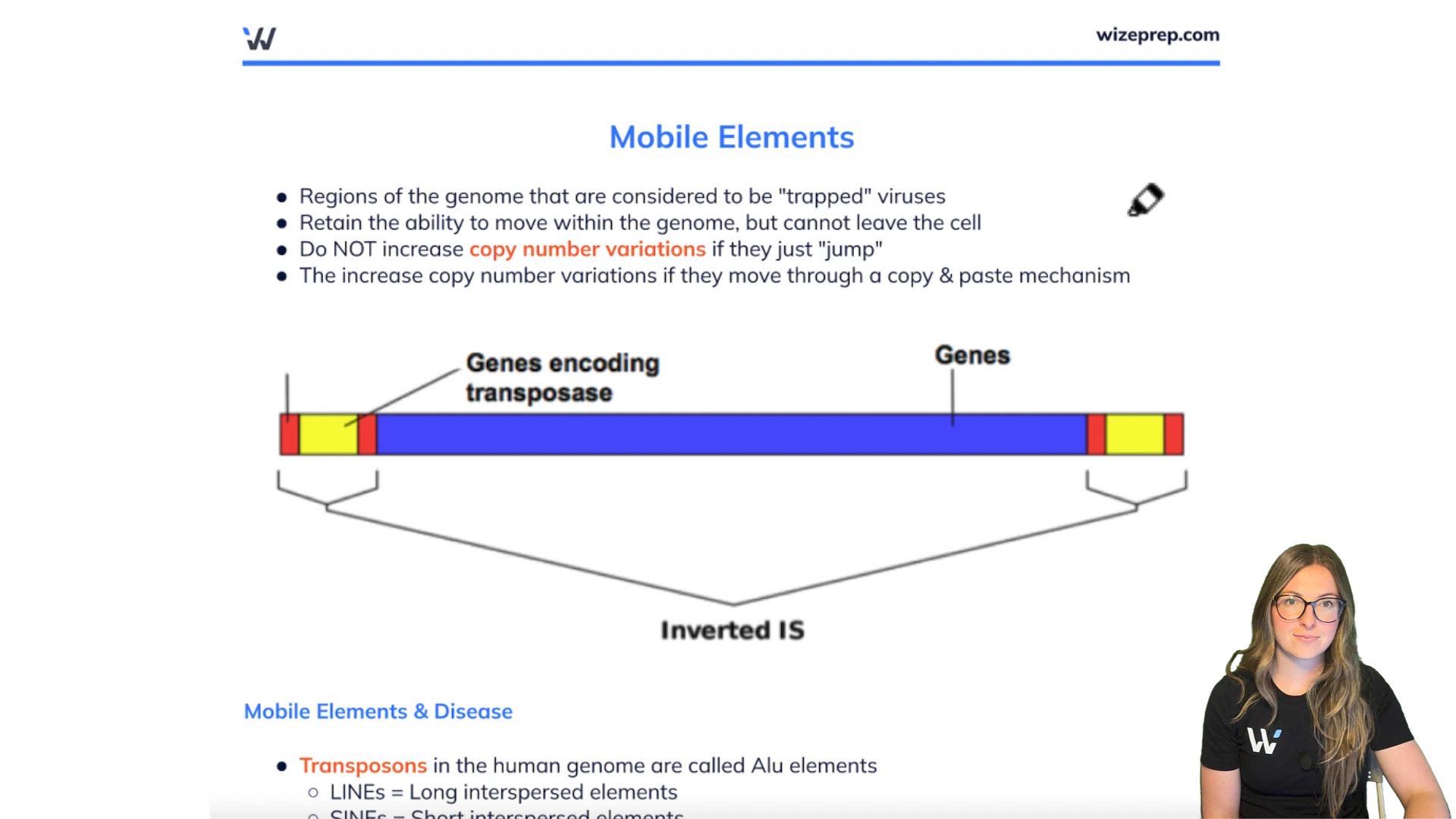
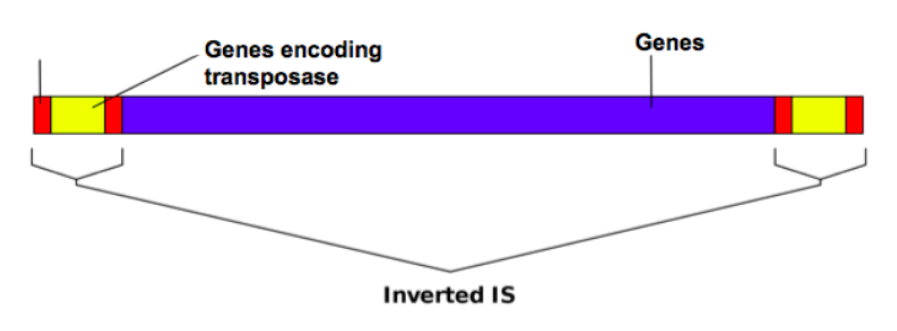
- Regions of the genome that are considered to be "trapped" viruses
- Retain the ability to move within the genome, but cannot leave the cell
- Do NOT increase copy number variations if they just "jump"
- The increase copy number variations if they move through a copy & paste mechanism
Mobile Elements & Disease
- Transposons in the human genome are called Alu elements
- LINEs = Long interspersed elements
- SINEs = Short interspersed elements
- Alu elements represent approximately 11% of the human genome = millions of copies!
- They move through a retrotransposon copy & paste mechanism
- The "paste" process causes insertional mutagenesis
- Insertional mutagenesis can disrupt genes, causing changes in gene expression or regulation and can cause recombination events to occur where they shouldn't
- Diseases attributed to Alu elements: Hemophilia, leukaemia, muscular dystrophy and MANY more!